Your Vagus Nerve: The Missing Piece to Your Chronic Health Issues
Your Vagus Nerve: The Missing Piece to Your Chronic Health Issues
What you need to know…
Let’s go to Vagus…
The Vagus Nerve, the longest of our cranial nerves, originates at the base of the brain and travels to the abdomen. It functions as a type of “body alarm system,” working with the brain to assess the safety of our environment - while also regulating heart rate, blood pressure, breathing, and digestion.
The vast majority (80%) of signals the vagus nerve receives are afferent - coming from the body to the brain. The remaining 20% (efferent signals) are sent from the brain out to the body.
Based on the signals, it works with the amygdala (fear center part of the brain) to quickly determine what is a perceived threat and what isn’t.
“Perceived” is the keyword here. Oftentimes, our vagus nerve can be a bit trigger happy – determining something is a threat and moving our body into the high stress Fight, Flight, or Freeze response. When in actuality, things aren’t that serious.
A real life example would include feeling anxious before an important presentation - our heart races and breathing increases - as we prepare to “out run” the imaginary lion.
Whew, the coast is clear, now what?
In an ideal world, after the threat has passed, our vagus nerve shifts back into a more calm state referred to as “ventral vagal”- as has been described by Dr. Stephen Porges’ polyvagal theory. Moving between these vagal states - from high to low stress - is supposed to occur automatically – so our body doesn’t stay in the high stress states for extended periods of time. However, this doesn’t always go as planned…
Got excess Inflammation? Listen up…
For many of us with autoimmune and chronic health issues, we live in a constant state of “Fight, Flight or Freeze,” as opposed to moving into those high stress states only when true danger is present. At times, we can become so accustomed to this high stress state, that we don’t even notice it anymore.
Modern stressors such as a toxic work environment, inadequate sleep, or even watching the news can all impact our vagal state.
Additionally, things like unresolved grief or trauma - where the unconscious mind believes it is still in the midst of danger, can keep us in a heightened vagal state, too. Overtime, living in a prolonged high stress state takes a toll on our health.
Imagine it like driving a car at 100 mph for years - at some point, the engine can’t take it anymore…
So, now what?
The next time you’re dealing with a mysterious headache or ailment, it may be best to reframe it and get curious.
Ask yourself the following question: What is going on in my life right now that is highly stressful or mentally taxing? It’s important to be really honest with your response.
Instead of being angry or frustrated at your body for your symptoms, it may be helpful to reframe your symptoms as your own personal “check engine” light.
I’ve found that when I listen to the early warning signs – the exhaustion, the tension headache - and honor what my body is asking for…rest; it doesn’t NEED to pull the five-alarm fire of symptoms. It knows that I got the message.
Ultimately, your body is focused on your long-term survival. If it’s concerned that your survival is threatened, how else is it going to get your attention?
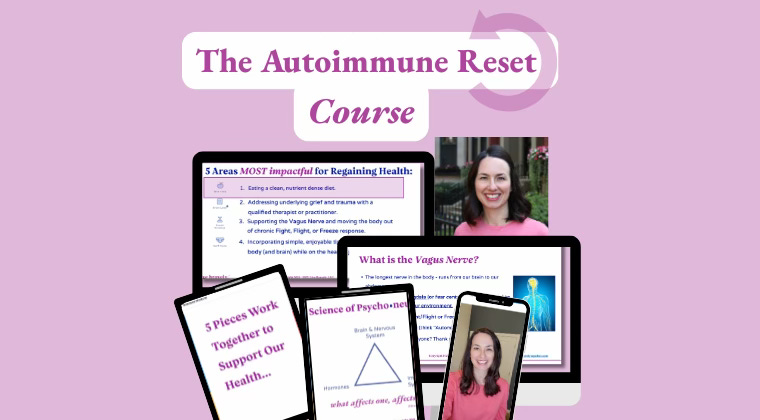
If you found this helpful, and you’d like to learn more about the impact of our vagus nerve on your health. I devote a whole section to it in my course, The Autoimmune Reset.
Serving all of the Northeastern United States of America (USA) Massachusetts, Vermont, New Hampshire, Maine, Connecticut, Rhode Island, New York, and New Jersey.